Red’s death and burial
Straight ManRed’s death and burial are the cruelly compressed ending of William Henry Devereaux, Jr.’s campaign to earn a dog and a lasting childhood memory of his father. The hoped-for pet arrives not as a lively puppy but as an elderly, barely mobile Irish setter; before the family can give her a name, she is dead. At the graveside, the boy supplies the name Red, while the scene fixes his father not as a celebrated scholar but as a man struggling with a borrowed shovel and the reality of a small, immediate loss.
The Bargain and the Unexpected Dog
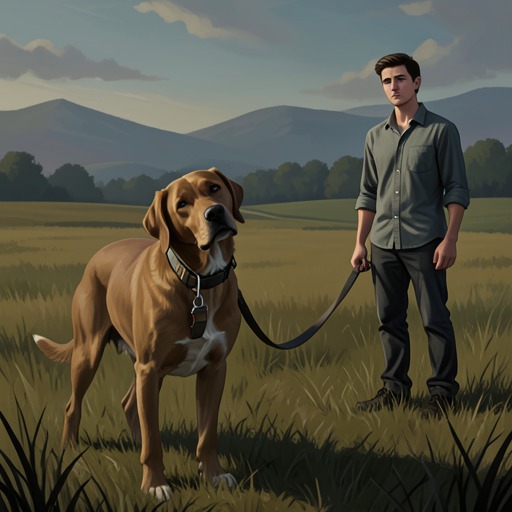
The dog’s arrival follows a condition set by the boy’s mother: he must stop slamming the screen door. Its spring made it bang with startling force throughout the house, and she had tied the possibility of a dog to his changing that habit. In late August, after recognizing that she was unlikely to yield on the matter, William Henry Devereaux, Jr. genuinely tried. He remembered to close the door gently about half the time, and when he forgot, he sometimes returned to apologize. He also carried an expensive collar and leash wherever he went, making the desired dog a physical presence even before one existed in the house.
At the end of that first week of improved behavior, his father left on a Saturday morning without saying where he was going. The boy inferred what the errand meant and pressed his mother to tell him what kind of dog they would get; she claimed not to know and said it was his father’s doing. The anticipation had been shaped entirely by the boy’s imagination: puppies, or at least a young, energetic dog with tricks to learn. Nothing in the promise had guaranteed that picture.
His father returned with a dog in the backseat of the car. Seen from the kitchen window, she rested her chin on the rear seat and did not appear to notice that the car had stopped. Her father had to move the front seat, take her by the collar, and pull her out. She unfolded her long legs and stepped down tentatively, with an arthritic, almost immobile gait. The disparity between the animal and the boy’s imagined puppy is the first reversal: the long-awaited dog is real, but almost the opposite of the spirited companion he had pictured.
Red’s Brief Arrival and Death
The dog was a meticulously groomed, rust-colored purebred Irish setter, handsome and well mannered. She had belonged to a university professor emeritus who had been placed in a nursing home earlier that week, leaving her without her former owner. To the boy, she seemed less like a creature ready to play than like a painted or portrait dog, one so still that she might have been selected precisely because she would not disturb a household with a no-pets clause. The thought that his parents had chosen a dog they would scarcely have to manage sharpened his sense of disappointment, though the dog herself is presented as vulnerable rather than culpable.
His father brought her into the kitchen, carefully closing the screen door behind them. The boy registered his own devastation; his mother looked from him to his father. The boy corrected his father when he referred to the dog as a male: she was a female. Later, when his father asked what to name her, he again used the wrong pronoun. Frustrated, the boy announced that he wanted to go outside and play, then bolted through the screen door. It slammed behind him with its familiar report.
As he leapt down the steps, he heard a dull thud from the kitchen and his father’s startled exclamation. The boy returned cautiously, intending to apologize for the door. Through the screen, he saw his parents standing over the dog, who seemed to be napping; his father nudged her haunch with the toe of his cordovan loafer. The account gives no cause of death. It moves from the apparent nap to the realization that the dog is dead, leaving the abruptness—and the boy’s attempt to repair one familiar mistake just as another, irreversible event has occurred—to carry the shock.
The Grave and the Name
His father dug a grave in the backyard with a shovel borrowed from a neighbor. The labor was at odds with his soft hands, which blistered easily. William Henry Devereaux, Jr. offered to help, but his father only looked at him. Standing thigh-deep in the hole, he shook his head in disbelief and said, “Dead,” adding, “Before we could even name him.” The misgendering continues even after the dog’s death; the boy understands that correcting it again would not change what has happened.
The father climbed out and went to the back porch, where the dog lay beneath an old sheet. He handled the sheet carefully, reluctant to touch anything dead, even something only newly dead. Using it to lower her into the grave, he had to let her drop the last foot. After the body struck the earth, he looked at his son and shook his head. He leaned on the shovel before beginning to fill the hole, apparently waiting for the boy to speak. The answer was “Red.” When his father did not understand, the boy explained that they would name her Red. The name comes not before the loss, as the father’s question had anticipated, but at the burial, when naming is all the child can still do for the dog.
The Memory’s Meaning
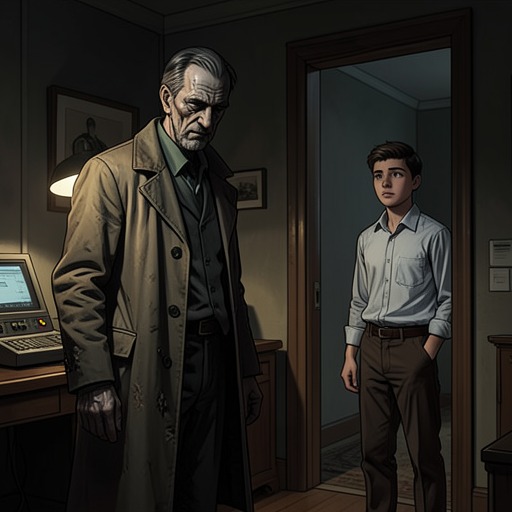
The scene is narrated retrospectively by William Henry Devereaux, Jr., who sets the image of the graveside against his father’s later public stature. William Henry Devereaux, Sr. becomes a celebrated scholar, is associated with American literary theory, writes books of scholarship and a literary memoir, and appears in literary reviews in his book-lined university office. Yet the son identifies the father’s most real image not with that polished, public life, but with ruined cordovan loafers, dirty and blistered hands, a borrowed shovel, and the proposal of a name for a dead dog.
That contrast makes the burial more than an account of a pet’s death. For the boy, his father seems to have encountered an experience that did not originate on a printed page; for the adult narrator, the memory also reveals how differently a parent and child can inhabit the same moment. The father looks at his son’s suggested name as if the boy himself were a character in a book he had begun long ago and abandoned. The image gives emotional shape to the gap between them: the father’s bewilderment at the child’s independent perception meets the child’s effort to make a small act of naming matter. Red’s short life ends before the family can welcome her into its imagined future, but the burial becomes a durable record of the boy’s disappointment, the father’s discomfort with death, and their difficult, intimate proximity.